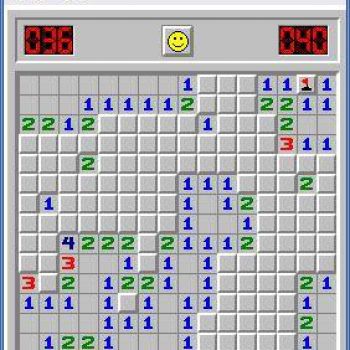
Discover the Classic Puzzle of Minesweeper
Why the grid still captivates players
Minesweeper offers a timeless challenge that blends logic, deduction and a hint of risk. The simple visual of a rectangular grid hides a complex mental exercise that rewards careful thought. Players of all ages find themselves drawn to the quiet satisfaction of clearing a board without triggering a hidden mine.
The simple premise that hides deep logic
The game begins with a concealed field of squares. Some squares hide explosive mines while the others are safe. When a safe square is revealed it shows a number that tells exactly how many mines touch that square. From these clues the player must infer which unopened squares are safe and which must be marked as dangerous.
Key Elements That Define the Experience
Variety of board sizes and mine counts
Different difficulty levels adjust the dimensions of the grid and the number of hidden mines. A small board with few mines provides an easy entry point, while a large board packed with many mines creates a demanding test of concentration. This range allows beginners to learn the basics and experts to push their limits.
Clear visual feedback and straightforward interaction
Each action produces an immediate visual response. A revealed number appears in a distinct colour, a flagged square shows a small marker, and a mine explosion displays a bright red icon. The clarity of these cues helps players stay oriented and make informed decisions throughout the game.
Effective Approaches to Clear the Board
Reading numbers to locate hidden mines
The core of the strategy lies in interpreting the numbers that appear on the board. A “1” means exactly one of the surrounding eight squares contains a mine. A “3” indicates three mines among those neighbours. By comparing overlapping clues players can pinpoint the exact locations of mines without guessing.
Balancing certainty with educated guesses
Occasionally the clues do not provide enough information to determine a safe square with absolute certainty. In those moments a player must weigh the probability of each hidden square containing a mine. Making a calculated guess based on the overall distribution of remaining mines often leads to progress while minimizing risk.
Advice to Improve Your Success Rate
Start with the corners to reduce uncertainty
Opening a corner square early often reveals a low number or a blank space. This creates a small safe area that can be expanded outward, giving the player a foothold before tackling the more crowded central region.
Use flags wisely to keep track of suspected mines
Placing a flag on a square you believe hides a mine helps prevent accidental clicks on that square later. It also serves as a visual reminder of the deductions you have already made, making it easier to focus on the remaining unknown squares.
Check the edges for patterns
The outer rows and columns have fewer neighbours, which can simplify the deduction process. Numbers on the edge often have only three or five adjacent squares, allowing quicker identification of safe moves.
How to play
Opening a fresh board
- Select a difficulty level that matches your skill.
- Click a cell to reveal its content.
Understanding the numbers and safe moves
- Each revealed number tells how many mines touch that cell.
- Mark cells you suspect contain mines with a flag.
- Use the information from revealed numbers to decide which unopened cells are safe.
Ending a game
- If you click a mine the game ends and all mines become visible.
- If you successfully flag every mine and reveal all safe squares you win the game.
Frequently Asked Questions
Can I change the difficulty after starting a game?
No. The difficulty is set before the board appears and cannot be altered during play.
What happens when I click a mine?
The game ends immediately and the board reveals the location of every hidden mine.
Is there a way to undo a mistake?
There is no built‑in undo function. You must start a new game to try again.
Do flags affect the score or timing?
Flags are only a visual aid. They do not add or subtract points and they do not influence the timer.
How can I improve my speed without sacrificing accuracy?
Practice recognizing common number patterns, use the edges to build safe zones quickly, and keep your flag usage organized to avoid accidental clicks.